
Though Hexapods have gained popularity since the invention of the computer (trying to do all of that math in your head proved to be a challenge), they are not a new invention. In the 1800's, a French mathematician named Augustine Louis Cauchy, was a pioneer in mathematical analysis. He proved calculus theorems, studied optics, mechanics, elasticity, and stress. Cauchy's work has been applied not just in mathematics, but in many practical engineering applications. It's even still found in modern control theory textbooks. Cauchy also looked at the stiffness of an "articulated octahedron;" an early design of the modern day Parallel Link Mechanism.
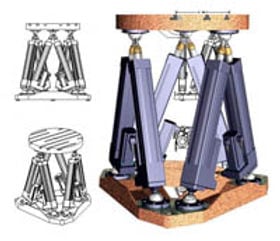
A HEXAPOD, or Stewart Platform, is a parallel link manipulator that utilizes an assembly of six struts to provide motion and accuracy for positioning. It has six degrees of freedom (usually listed as x, y, z, pitch, roll, and yaw). If you remember your physics lessons you know that there are only six degrees of freedom available. Therefore, if you build a Hexapod, it is not only capable of moving in any possible direction and orientation, but it is also in control of all these motions.
However, it was not named the "Cauchy Platform." In 1949, V. E. Gough built and used a parallel mechanism called the "Universal Tyre-Testing Machine" at the Dunlop Rubber Company in England. This machine, or "Universal Rig" as it was called, was able to mechanically test tires under combined loads. The original machine built by Gough was in use until the 1980's, and is currently owned by the Science Museum of London. But, no, it is not known as the "Gough Platform" either.
MIKROLAR is involved in many areas of Hexapod development, including bio-mechanical research, flight and driving simulators, industrial applications, and more (applications). Whether you need a "tyre tester," or something out of the ordinary, we specialize in Hexapods, Stewart Platforms, Parallel Link Mechanisms, Parallel Robots, Parallel Kinematic Manipulators, Motion Bases, or whatever else they may be called (robotics, actuators, and client profiles). It's what we do.
In 1965, an engineer named D. Stewart published a paper describing a 6-DOF motion platform for use as a flight simulator. Since that time, almost every type of parallel mechanism has been commonly referred to as a "Stewart Platform," despite Cauchy, Gough, and many others having laid the foundation work in both theory and actual applications. That we know of, D. Stewart never actually build a flight simulator -- but Klaus Cappel did.
We base our custom robots on the Hexapod system, which provides the opportunity for a high load capacity and range of movement, while maintaining a high degree of precision and repeatability. To produce these robots, we custom design and build very accurate and repeatable servo-controlled linear actuators. We also supply these actuators to companies looking for precise, repeatable, and reliable linear motion.
Essentially, if you have a special requirement for your application, we can design a robot to meet that need. We have built systems that can fit in your hand, or touch a 20-foot-tall ceiling. Our robots position and assemble thousands of 2- oz light bulbs per hour. We have pressed 160,000-pound loads, and assisted with the calibration of the James Webb Space Telescope mirrors to less than one micron.
MIKROLAR is a small, veteran-owned business located in NH that specializes in building customized robotics. These are designed to be more accurate, repeatable, faster, stiffer, and able to carry a larger payload than conventional robotics. We also integrate these devices with vision systems, spindles, waterjet cutters, lasers, Renishaw Touch Probes, and various end effectors and load cells.
Are you looking for a device that provides a result on the cutting edge of what is available, or needs to be specialized in some way? Mikrolar’s approach offers a reliable solution that mitigates risk, and provides a system that is simple to learn, operate, and customize.
Mikrolar has implemented these devices in organizations such NASA, Boeing, Draper Laboratories, Adidas, Nike, Ball Aerospace, Sikorsky, as well as extensive bio-mechanical research in Universities and Laboratories throughout the Americas, Europe, and Asia.
官网:https://www.mikrolar.com/about
资料来源:企业官网公司介绍页面(复核日期:2026-10-29)。